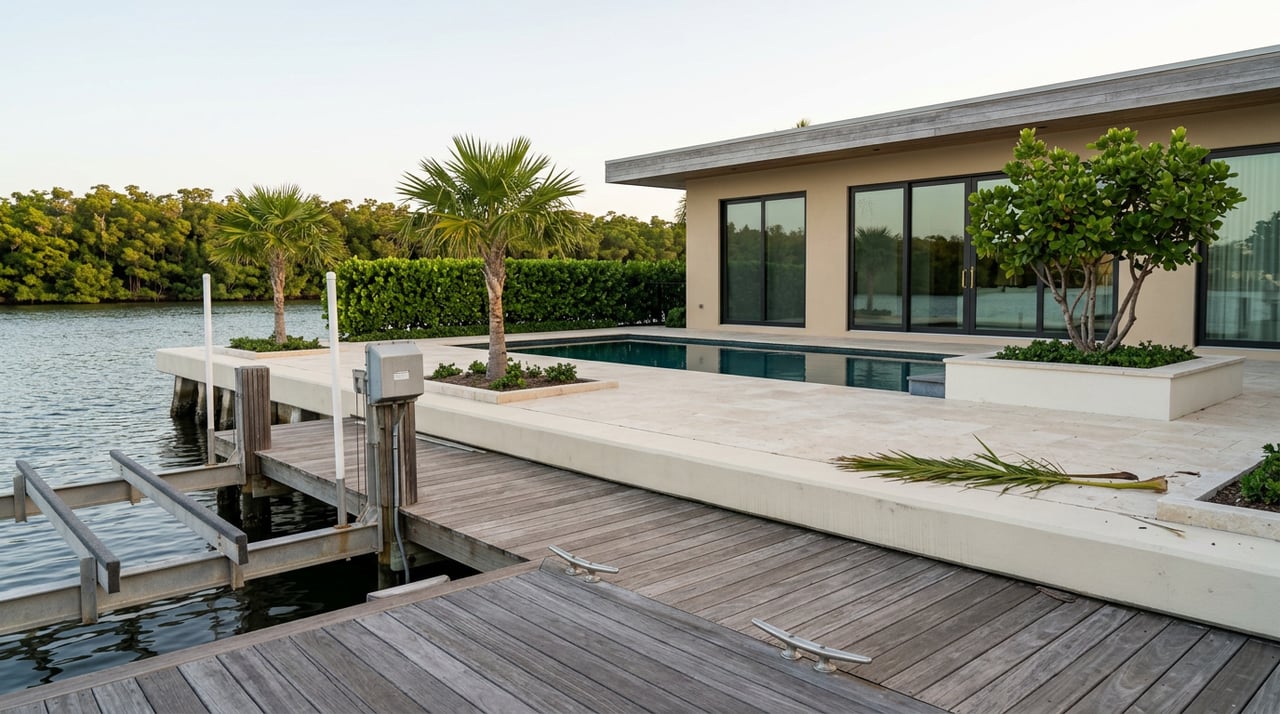
In North Palm Beach, the Same Waterfront Price Can Buy a Different Boat
September 10, 2026
September 10, 2026
A buyer who wants a dock in North Palm Beach usually shops the way any waterfront buyer shops. Depth at the seawall, square footage, view of the water. What the listing sheet almost never tells you is whether your boat can actually leave that dock and reach the Atlantic without waiting on a bridge schedule, or whether the slip pictured in the listing photos belongs to the home at all.
Those two questions matter more than price per square foot for anyone shopping waterfront in this village, and they explain why two properties asking the same number can deliver entirely different boating lives.
North Palm Beach sits at the northern end of the Lake Worth Lagoon, a 21-mile estuary that connects the village to Singer Island, Peanut Island, and the inlet beyond. Inside the village, a network of inner waterways wraps around the North Palm Beach Country Club, crossed by three internal bridges at Parker, Lighthouse Drive, and Earman. The village is roughly 38 percent water by area, which is part of why boating shapes so much of daily life here.
But the water inside the village isn't one continuous, unrestricted route to the ocean. Two drawbridges on the Intracoastal Waterway, at Donald Ross Road and PGA Boulevard, operate on a fixed federal schedule, opening on the hour and half hour rather than on demand. Local reference points put the Donald Ross Road bridge at roughly 35 feet of vertical clearance when closed, a real ceiling for many sailboats and hard-top pilothouse yachts. A boat docked south of that bridge with a mast or flybridge taller than the closed clearance either times every outing around the schedule or waits for an opening.
Compare that to a marina positioned north of both spans. Safe Harbor Old Port Cove sits on a 60-acre peninsula off the Intracoastal at Coast Guard Channel Marker 27, about four miles north of the Palm Beach Inlet, and the marina's own materials describe the route as having no span bridges to slow a boat down. That single geographic fact, not the price of the dock, is what determines whether a 60-foot flybridge yacht can come and go on its own schedule or someone else's.
Here is how the two ends of that same waterway compare on paper:
| Location | Position relative to fixed bridges | Reported depth | Vessel accommodation |
|---|---|---|---|
| Donald Ross Road Bridge | Fixed span, ICW | ~35 ft closed clearance, opens on the hour and half hour | Limits air draft for tall sailboats and flybridge yachts south of it |
| PGA Boulevard Bridge | Fixed span, ICW | Same federally scheduled opening pattern | Same routing constraint further south |
| Safe Harbor Old Port Cove | North of both bridges, off Channel Marker 27 | Approach and dock depth around 12 feet | Accommodates vessels from 20 to 200 feet LOA |
| Safe Harbor North Palm Beach | Sheltered basin, about a mile from the inlet | Mean low water around 10 feet | Robust slip inventory close to the inlet |
Depth alone tells you whether your hull clears the bottom. It says nothing about whether your mast clears a bridge, or whether that bridge even opens when you want it to.
The second question a waterfront listing rarely answers cleanly is whether the dock is actually yours.
In some North Palm Beach condo communities, the boat slip is deeded, meaning it is real property that conveys with the unit's title, the same as a parking space that's legally yours rather than assigned by a landlord. One listing example we came across is explicit about this structure: the slip is a deeded 40-by-16 dock with a 16,000-pound lift, and it must be purchased together with the specific condo unit it's attached to. It cannot be bought or sold on its own.
Other communities handle dockage the opposite way. In at least one waterfront condo building, the association offers rental boat slips to occupying owners at a rate of three dollars per foot, up to 33 feet. That slip isn't an asset the owner holds. It's a use privilege the association controls, priced and reassigned at the board's discretion.
Twelve Oaks, a waterfront condo and villa community built in 1983 with an on-site marina, illustrates a middle version of this same pattern: the marina exists as a shared amenity of the community rather than a slip attached to any single deed. That structure means a buyer's dockage rights depend on the community's specific bylaws, not on any assumption carried over from a different building down the street.
None of this shows up as a clean line item on a listing sheet. It shows up in the condo documents, the deed itself, and sometimes only in a phone call to the association.
The gap between assuming a dock is deeded and discovering it's a revocable rental slip isn't a paperwork inconvenience. It's the difference between owning a transferable asset that adds resale value and holding a privilege that can be repriced or reassigned by a board vote. For a buyer who chose a property specifically because it came with dockage, that distinction changes what they actually paid for.
The bridge question carries its own cost, just a slower one. A buyer who closes on a property south of Donald Ross Road or PGA Boulevard without checking bridge clearance against their vessel's air draft doesn't find out until the first time they try to leave. At that point the fix isn't a phone call. It's either a different boat or a different dock.
Village-level median price data gives a general sense of where the broader market sits (over the three months ending May 2026, the median sale price across all North Palm Beach housing types was reported at $510,000, down modestly from the same period a year earlier) but that figure blends condos, canal homes, and inland properties together. It tells you nothing about what a specific dock, on a specific stretch of water, actually allows a specific boat to do.
A waterfront listing photo of a dock is not proof of what that dock is. Before treating boating access as settled, a buyer should confirm:
None of these questions are answered by square footage or list price. They're answered by documents, phone calls, and in some cases a literal test run at a representative tide.
Does a "deep water" listing guarantee my boat can reach the ocean without a bridge wait? No. Deep water describes depth at the dock, not the route out. A property can have ample depth and still sit behind a fixed bridge with a scheduled opening that has nothing to do with tide or draft.
Can I buy a deeded boat slip without buying the unit it's attached to? In the examples we've seen locally, no. Deeded slips are typically bound to a specific unit and sold together as one transaction, not offered separately on the open market.
What actually separates a deeded slip from a rental slip? A deeded slip is real property that conveys with the title and stays with the owner regardless of what the association decides later. A rental slip is a use privilege the association assigns and prices, which can change independent of anything the boat owner does.
If you're comparing waterfront addresses in North Palm Beach and want a second set of eyes on what a specific dock actually conveys, John Reynolds & Randi Binder can help you get a clear answer before you write an offer. Get a Free Home Valuation to start the conversation.
This article is general information, not legal, tax or financial advice. Consult a qualified professional about your situation.
Stay up to date on the latest real estate trends.
Building unparalleled value in high-end communities, offering tailored strategies that maximize opportunity and deliver exceptional results across premier properties.