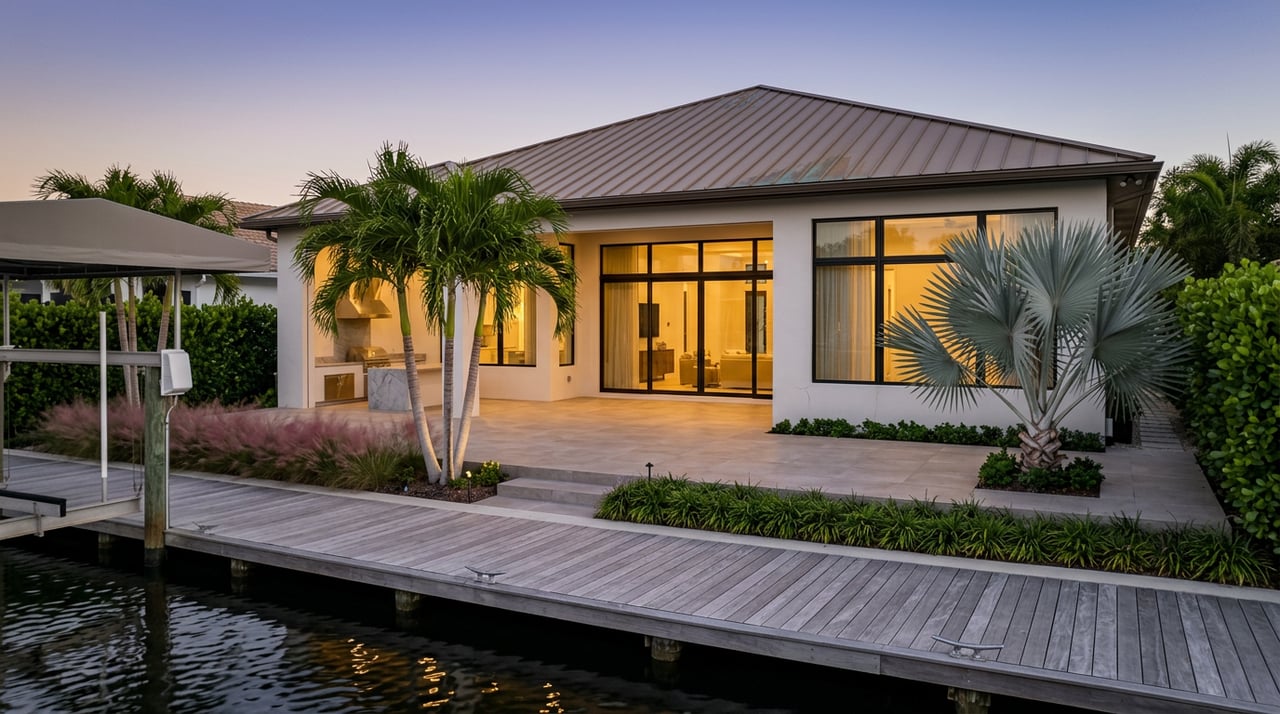
Jupiter Waterfront With No Fixed Bridges: Ocean Access Limits
September 17, 2026
September 17, 2026
On July 5, 2025, two boats ran aground within the same stretch of water near the Jupiter Inlet. Neither hit a bridge. There wasn't one in the way. The obstacle was the inlet floor itself, where a depth reading that boaters had trusted at 8.8 feet had quietly dropped to 6.2 feet at mean low water. Both vessels were drawing about five feet, with roughly a foot of tide to work with. That is not a wide margin, and it is the kind of margin a listing sheet never mentions.
If you have shopped Jupiter waterfront property, you have seen the phrase "no fixed bridges" attached to home after home, marina after marina, as though it settles the question of ocean access once and for all. It settles half of it. The bridges between a Jupiter dock and the Atlantic are, for the most part, genuinely generous. The inlet they lead to is not infrastructure at all. It is a live, shifting tidal channel that the Jupiter Inlet District manages on an as-needed basis, and it can close the gap that no bridge ever created.
Start with what "no fixed bridges" is actually describing, because on the bridge side of the ledger, it holds up well for most of the Jupiter waterfront corridor.
| Bridge | Type | Vertical Clearance | Schedule |
|---|---|---|---|
| Indiantown Road (SR 706) over the Intracoastal | Double-leaf bascule | 35 feet closed, per the Federal Register | Opens on the hour and half hour |
| U.S. 1 over the Loxahatchee River/Intracoastal | Twin double-leaf bascule, replaced and completed December 2025 | Up to 42 feet, 125-foot channel | Opens on demand |
| Alternate A1A over the Loxahatchee River | Fixed span | 25 feet at mean high water | Does not open |
The Florida Department of Transportation finished the U.S. 1 replacement late last year, and the new structure widened the navigable channel considerably while raising clearance to 42 feet, a meaningful upgrade from the bridge it replaced. Indiantown Road's bascule spans still open on a predictable hourly and half-hourly schedule under the federal drawbridge regulation that governs it. For a buyer comparing waterfront homes on the Intracoastal side of Jupiter, these two bridges are rarely the constraint. The one fixed span in the mix, the Alternate A1A crossing of the Loxahatchee River, is the exception: it does not open at all, and it caps vessel height for the many homes sitting behind it on the river side of town.
So for Intracoastal-facing property, the bridge chart mostly says yes. That is exactly why so many listings stop there.
A fixed bridge is a known quantity. It has a published clearance and it does not change with the tide chart or the season. The Jupiter Inlet is the opposite of that. It is a natural, actively managed tidal channel connecting the Intracoastal to the Atlantic, and its depth moves with sand transport, storm activity, and the calendar since the last dredging cycle.
The federal government's own navigational reference, the U.S. Coast Pilot, still describes Jupiter Inlet as a channel used primarily by small vessels of the local fishing fleet and marked by private lights rather than a full federal aid-to-navigation system. That is a different category of infrastructure than a bridge with a certified clearance. It means the "controlling depth" you find on an older chart or a listing photo caption is a snapshot, not a guarantee. Recreational boaters who transit the inlet regularly describe it as safe if you already know it and considerably less forgiving on an outgoing tide, which lines up with what happened on July 5, 2025.
The Jupiter Inlet District dredges on an as-needed basis rather than a fixed calendar, and its most recent sand-trap project wrapped up in April 2026. That is good news for anyone buying this year. It is not a permanent fact about the property. Shoaling can and does return between projects, which is the entire reason a fresh sounding at the time of purchase matters more than a general reputation for deep water.
The phrase means something different depending on how far a given dock actually sits from the inlet itself.
None of these communities is misrepresenting its bridges. The distinction that matters is how close a given dock sits to the inlet crossing itself, because that is where the tide chart starts to matter more than the bridge chart.
There is a second friction point buyers rarely hear about until they are already under contract: dock or seawall work may involve permitting.
If a Jupiter or Jupiter Inlet Colony property is on your list because of what a boat can do from the backyard, the diligence that actually protects you looks different from the diligence a typical listing description invites.
Ask for a sounding at low tide, not a general reputation for deep water, and ask when it was taken. Ask when the inlet was last dredged and by whom, since the Jupiter Inlet District's project cadence is public record. Confirm in the deed and the contract whether existing dock and lift permits transfer with the sale, and request the submerged land lease documents directly rather than taking a listing's word for it. And match your own vessel's draft against the specific route you would take, not the general claim that the community has no fixed bridges, since the bridges were never the part in question.
Does "no fixed bridges" mean my boat can always reach the ocean at any tide? Not necessarily. The bridges may open on demand or on a schedule with no clearance limit, but the inlet itself can still be shallow enough at low tide to matter for deeper-draft vessels.
How often does the Jupiter Inlet get dredged? On an as-needed cycle managed by the Jupiter Inlet District rather than a fixed calendar. The most recent sand-trap project was completed in April 2026.
If a house already has a dock, what should I check about the permits? Confirm the specific authorizations in the deed and sales contract.
Waterfront value in Jupiter is real, and for most buyers the bridges genuinely are the easy part. The inlet is where a fair number of assumptions quietly stop holding up, and it is worth a conversation before it becomes a surprise at the dock.
If you are comparing Jupiter waterfront addresses and want a second set of eyes on what a specific dock, a specific route, and a specific permit history actually add up to, John Reynolds & Randi Binder are glad to walk through it with you. Get a Free Home Valuation to start the conversation.
This article is general information, not legal, tax or financial advice. Consult a qualified professional about your situation.
Stay up to date on the latest real estate trends.
Building unparalleled value in high-end communities, offering tailored strategies that maximize opportunity and deliver exceptional results across premier properties.